
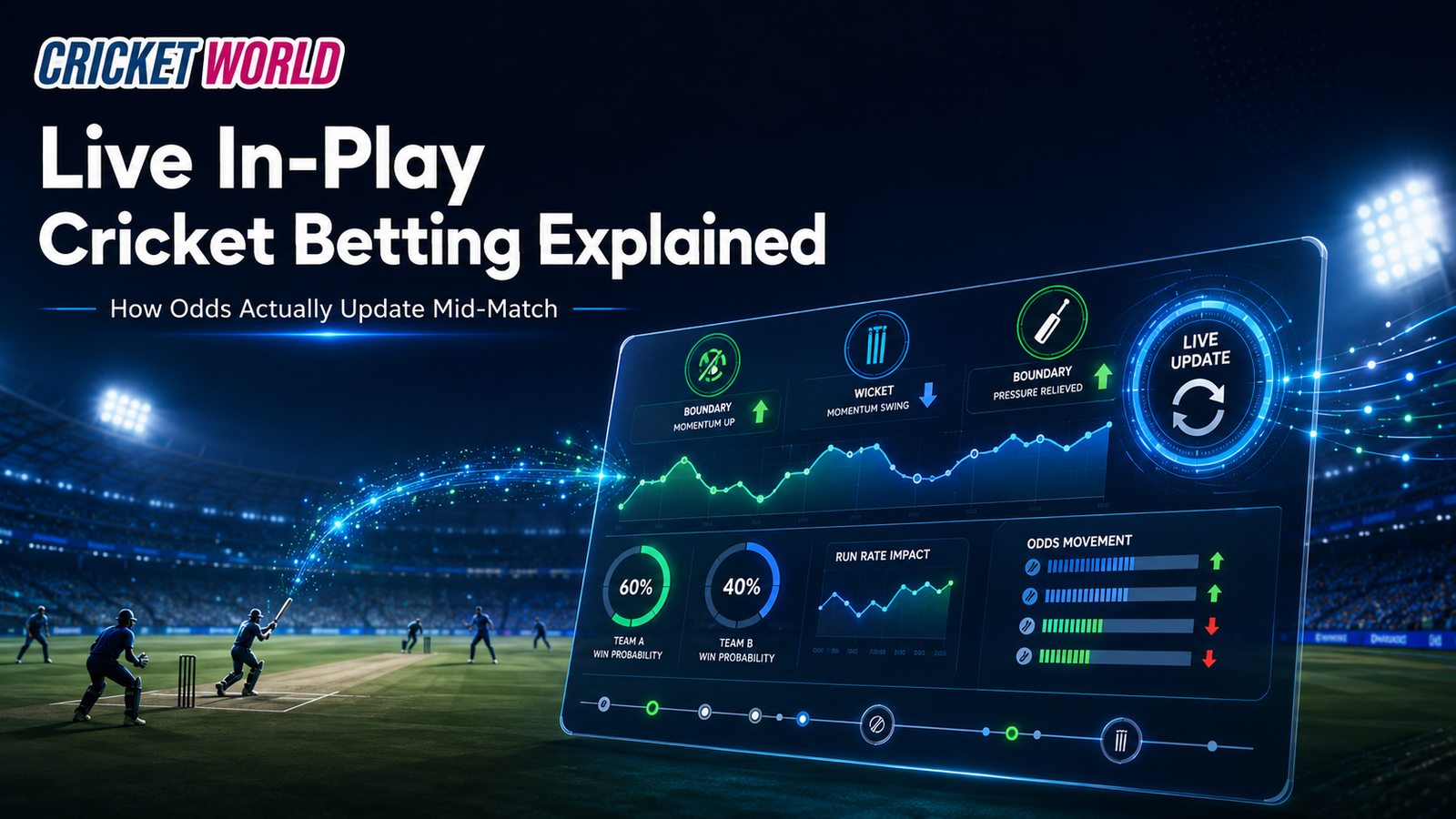
Pre-match odds are set once and stay put until the toss. Live in-play odds do the opposite — they move constantly, sometimes shifting between one ball and the next. Live in-play cricket betting explained simply: instead of locking in a view before the match starts, you’re reacting to a price that’s recalculating itself in real time, based on what’s actually happening on the field.
If you’ve only ever placed a pre-match bet, watching a live market for the first time can feel disorienting — the number keeps changing, and it’s not always obvious why. Once you understand what’s driving those shifts, it stops feeling random.
What Actually Moves an In-Play Price
A live cricket odds engine is constantly re-pricing the outcome based on the current match state. A few things move it more than others:
Wickets. Losing a set batsman shifts a match-winner price more sharply than almost anything else, especially in the middle overs when a team’s depth is being tested.
Run rate relative to the target. In a chase, the required run rate matters more than the raw score — a team at 120/2 chasing 140 is priced very differently from one at 120/2 chasing 200.
Overs remaining. The same required run rate means something completely different with 10 overs left versus 2 — odds account for how much time there actually is to execute.
Momentum within an over. A string of boundaries, or a tight over with no runs, can shift a price noticeably even without a wicket falling, since it changes the market’s read on how the innings is trending.
Why the Price Sometimes Moves Before You Expect It To
Live markets don’t just react to what’s already happened — they price in what’s likely to happen next. A team needing 8 an over with wickets in hand might see very little price movement even after a quiet over, because the market still rates their chances the same way. A team needing 12 an over with only the tail left batting can see a sharp price shift after a single dot ball, because that situation has far less room for error.
Reading a Live Market Without Chasing Every Move
The easiest mistake with in-play betting is reacting to every single ball as if it’s decisive. Most deliveries don’t meaningfully change a match’s outcome, and a price genuinely worth acting on usually follows a clear shift in the game state — a wicket, a required-rate change, a momentum swing across an over — not just the last ball bowled. Checking in at natural break points (end of over, fall of wicket, drinks break) tends to give a clearer read than watching every delivery.
Pre-Match vs In-Play: Different Skills, Not Just Different Timing
Pre-match betting rewards research done in advance — team news, pitch reports, head-to-head record. In-play betting rewards reading the game as it happens — understanding what a required run rate actually means at a given stage, and recognising which shifts in the match genuinely change the outcome versus which ones are just noise. They’re related skills, but they’re not the same one.
The Bottom Line
In-play odds move because the match itself is moving — wickets, required run rate, overs remaining, and momentum all feed into a price that’s recalculating constantly. Reading it well means checking in at meaningful moments rather than reacting to every ball, and understanding that context (how many overs are left, how many wickets are in hand) matters as much as the raw numbers on screen.
Frequently Asked Questions
Why do in-play odds sometimes barely move after a wicket falls?
Because the market weighs context alongside the event itself — a wicket with the team still well ahead of the required rate and depth in the order left moves the price less than a wicket in a tight chase with the tail exposed.
Is in-play betting more difficult than pre-match betting?
It’s different rather than strictly harder. Pre-match rewards preparation and research; in-play rewards reading the game’s context in real time as it unfolds.
How often do live cricket odds update?
They update continuously through the match, recalculating after significant events like deliveries, wickets, and shifts in required run rate.
Do I need a different ID for in-play betting?
No. In-play markets sit alongside pre-match betting under the same Cricket ID, with no separate signup required.
This article is for informational and educational purposes only and does not constitute betting advice. Online betting involves financial risk. 18+ only. Please gamble responsibly.